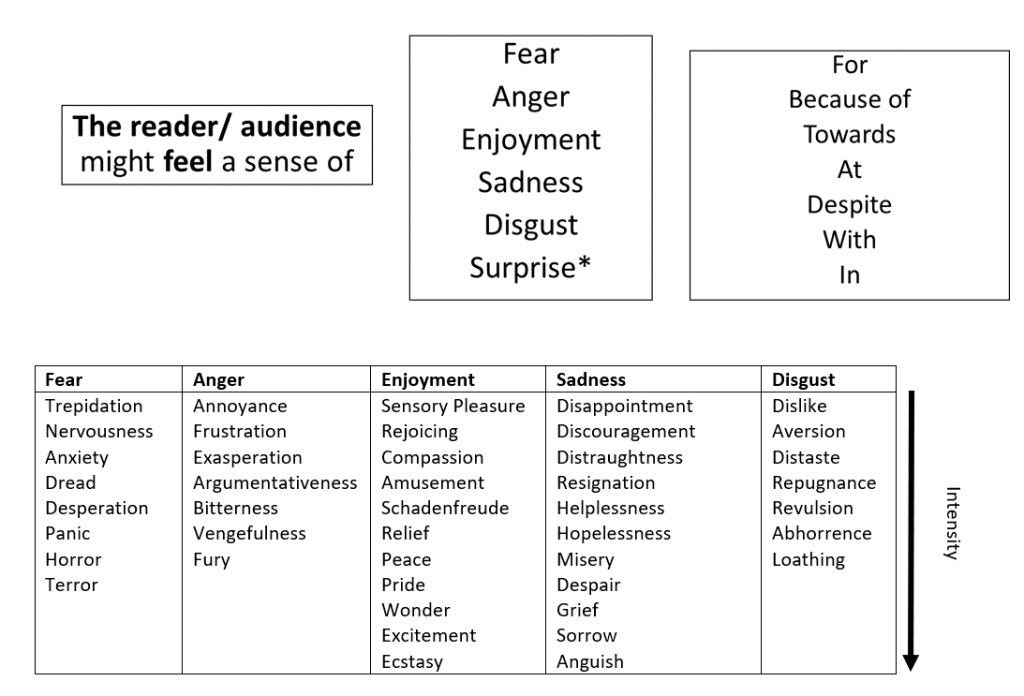
In 2022, several teachers were selected to partake in sessions with academics from Aston University’s English department. Dr Marcello Giovanelli, Dr Chloe Harrison, and Dr Megan Mansworth created an excellent programme where we, as attendees, gained greater insight into certain areas of contemporary stylistics. Three aspects were investigated: Text World Theory, Cognitive Grammar, and Reader Response. The first session of three, focussed on the three academics providing attendees with an overview of the areas. The next two sessions saw attendees collaborate on resources and then feedback about how the theory had been implemented in our different contexts. The final session was thus an opportunity to share some of the amazing resources that other attendees had utilised. The content on all three of the areas was deeply interesting and had an impact on my practice over the last twelve months. Soon after the first session, I developed a resource to aid students in addressing the emotional reaction of readers to fictional texts, with Megan’s input relating to Reader Response providing the stimulus for my ideas. Analysing a reader’s response to a fiction text is an area that often is weak in students’ writing, with responses often falling back on ‘readers feel sympathy’ as catch-all responses. After discovering Paul Ekman’s Atlas of Emotions (https://atlasofemotions.org/), I produced the resource below. Since using this in some of my classes, students have been able to articulate the emotional effect evoked by the text with greater precision. The use of this framework has also enabled students to track the changing emotions of characters throughout an extract, which has then led to conversations about how readers respond to these emotions. Are they similar to the emotions that we feel? Are they different? Does re-reading have an impact?
Yet, Text World Theory is the area of the programme that I have focussed on most in this academic year. In the first session, Marcello demonstrated a method of reading an extract to students and getting them to draw a picture of the scene. I, along with most of the attendees, have used this with our students. The popularity of this strategy can be found in both its simplicity, its potential to engage students, and its versatility.
In Year 10, prior to completing any exam-specific work, students study a range of texts in our ‘Exploring Fiction’ unit, which has the aim of developing student’s curiosity for reading different fictional texts. An early example of where I implemented this strategy was when we looked at an extract from Sam Selvon’s Lonely Londoners where the protagonist, Moses, takes a new immigrant, Galahad, to a London labour exchange. The extract describes a room ‘shape like a L’ filled with signifiers of the despair and the misery of those unable to find jobs: ‘some tests sit down waiting like guilty criminals’, ‘the floor dirty with footprint and cigarette butt’. After completing their drawings, students then completed a text world diagram. These were then discussed and added to. The example, like many student responses, picked up on the L-shape of the room; this student imagined being in the room, with one arm of the L being somewhat obscured from view. This activity provided a starting point for a whole-class discussion about what Selvon had foregrounded in the extract and what inferences could then be made about the setting. It is then through these, and similar, conversations that other elements of language (such as specificity, or narrative voice) can be introduced. These methods certainly enhanced the curiosity of students; given the declining rates of students taking A Level English (https://www.standard.co.uk/news/uk/alevel-association-of-school-and-college-leaders-english-action-england-b1019028.html), this is no bad thing!
In December 2022, I delivered a training session to the department about the sessions at Aston and the how I had included it in the classroom. Verbal feedback from the department was overwhelmingly positive. I introduced the department to Text World Theory and the idea of text world diagrams and text world drawings. I then modelled the process that I used with students. The department enjoyed the session with many colleagues commenting on how accessible the tasks were to all learners. Since this session, approximately half of the department have tried out this method with their own classes, all of them reporting back to me that it went down positively with students.
One suggestion that was provided by a member of the department was to use both a text world drawing and the text world diagram as a planning tool for creative writing tasks. I will now explain how I did so.
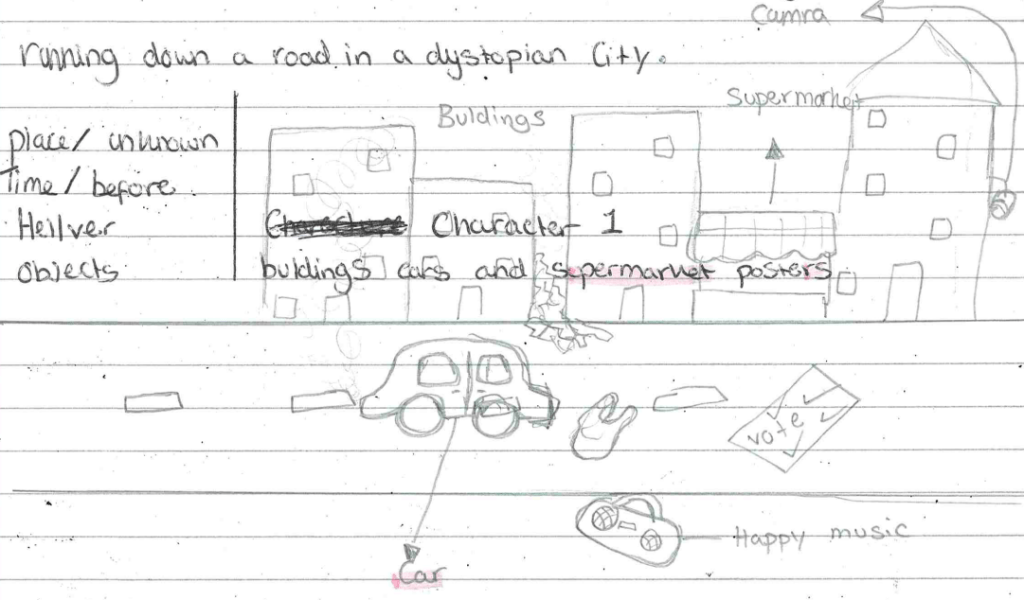
In our school, we teach a genre study unit to Year 9, where we explore two different genres. When teaching this class about dystopian fiction, many lessons included creating text world diagrams and some drawings. Later in the unit, I also implemented both as planning tools. When writing their own dystopian fiction, I instructed students to draw a text world diagram as the initial stage of their planning. This enabled them to have a clearly defined physical setting, and temporal setting, with the objects that make up these spaces. This proved to be an effective planning tool, with a teaching assistant commenting on the merits of the simple structure that is easy for students to follow.
As this unit progressed, it became clear that students needed greater focus on ‘writing a lot about a little’ in their own fiction. The text world drawing proved to be an effective strategy. In one lesson, I asked students to draw the text world that they wanted their potential readers to imagine – one example is provided below. (This was after the text world diagram was used for the planning.) Students then used their drawing to begin the writing process. This enabled them to spend longer than previously describing the individual components of their setting to build atmosphere and intrigue, thus helping to prevent them from rushing on and falling into the simple ‘and-then’ structure that can appear in some students’ work. In relation to the example, this student then produced a description that included nearly all the components that they included in the drawing. Using the drawing first helped increase the level of detail that students produced.
As is clear from the above, text world drawings and diagrams has been the aspect of the programme at Aston that has been most prominent in my own practice. The content on reader response has been used regularly with classes. Chloe’s delivery of some of the components of Cognitive Grammar was fascinating and thought provoking; I want to embed this area more.
Any English teachers reading this series of blog posts would be well-advised to try out some of the ideas mentioned with their classes; they enhance the content!
 appliedstylistics.com