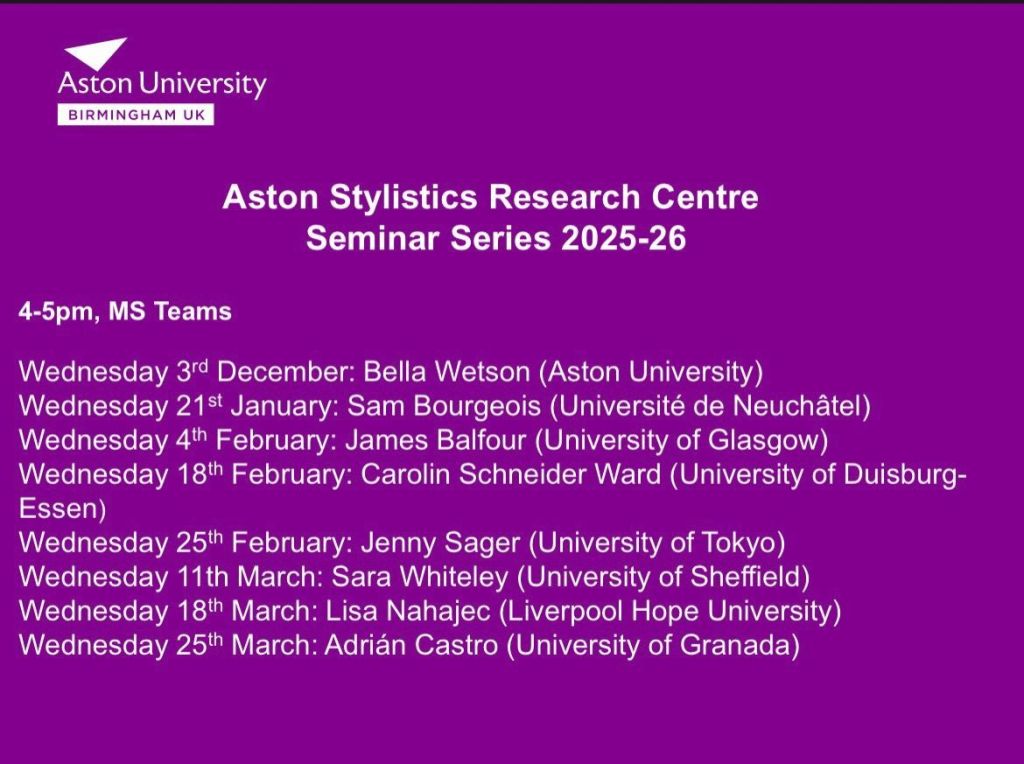
Applied Stylistics Seminar – Adrián Castro
How fantasy worlds are built: corpus and cognitive stylistic evidence from The Wheel of Time and The Dark Crystal: Age of Resistance
25th of March 2026, 4-5pm, Teams
Book your place here and find more details about the talk below:
Adrián Castro is a PhD researcher in English Literature and Linguistics at the University of Granada. His interests lie in corpus linguistics/stylistics, pop culture and discourse analysis. He has published articles on the telecinematic stylistics, music-in-fantasy literature and worldbuilding with particular attention to the stylistic construction of fictional worlds across media.
This paper presents work in progress that brings together corpus and cognitive stylistics to examine how fantasy worlds are constructed across media. Focusing on The Wheel of Time and The Dark Crystal: Age of Resistance, it argues that worldbuilding is not a by-product of fantasy but a conscientious process that can be examined through language use and, in television, through the interaction between verbal and non-verbal resources. In The Wheel of Time, corpus-stylistic analysis of the first novel and season one identifies frequently used lexico-grammatical elements related to geography and spatial deixis, world completeness and entity-reference, showing that the construction of a secondary world relies on a relatively stable set of elements across literature and television. In The Dark Crystal: Age of Resistance, a tripartite method combining keyword analysis, multimodal shot-by-shot analysis and schema theory shows how the opening sequence guides the viewers’ understanding of the storyworld by means of the interaction of dialogue and multimodal resources, organizing the knowledge required to grasp the constraints and rules of the fictional world. Taken together, the two case studies show that, in fantasy fiction, the construction of worlds is an extremely important process that seeks to fix the entities, relations, scale and rules of the world for readers and viewers to be able to orient themselves in an otherwise non-existing world.
 appliedstylistics.com