Applied Stylistics Seminar – Dr Carolin Schneider Ward
“¿Quantos me dejiste?” – Investigating Social Epistemics of Autobiographical Questions and Answers in Bilingual Dementia Contexts
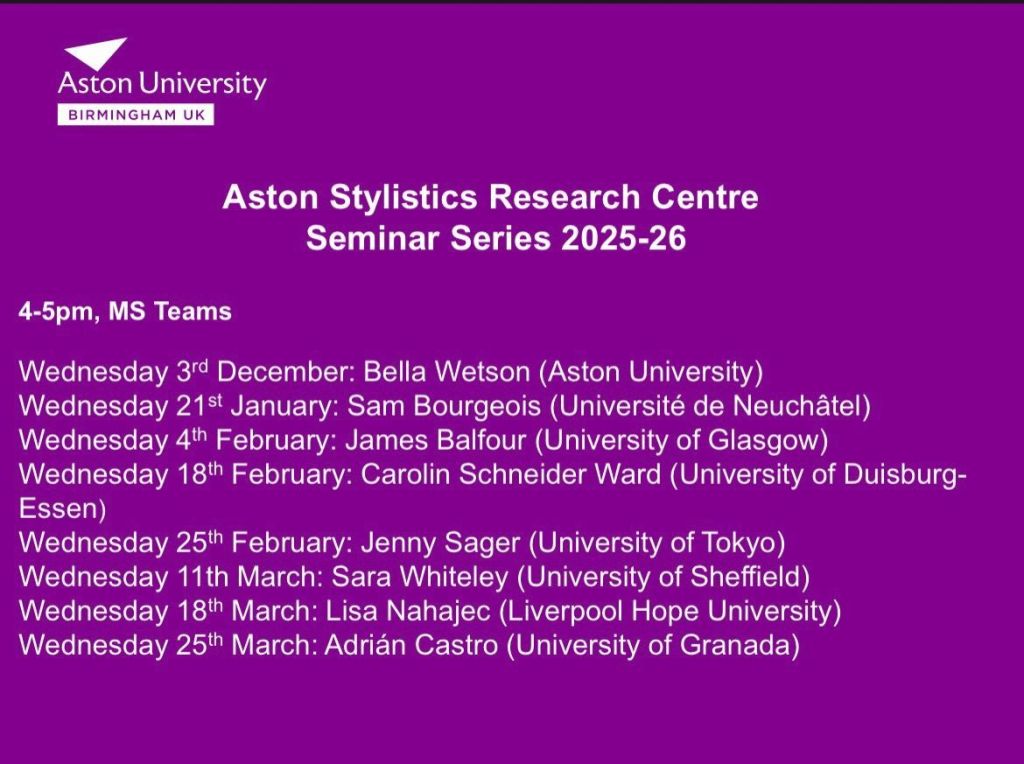
18th of February 2026, 4-5pm, Teams
Book your place here and find more details about the talk below:
Carolin Schneider Ward is a postdoctoral researcher in English Linguistics at the University of Duisburg-Essen. Her research focuses on (digital) health communication and multilingualism, with an emphasis on discourses with and about dementia. Her publications include An Ethno-social Approach to Code-Choice and Code-Switching in bilinguals living with Alzheimer’s (2023) and several peer-reviewed articles as well as a special issue co-edited on Dementia in Social Media Discourse and Digital Interaction (2026).
This talk examines how knowing, remembering, and understanding are negotiated in bilingual conversations involving people living with dementia. Addressing a gap in research on epistemics in bilingual dementia contexts, it explores how epistemic stance (K+ and K−) (Heritage, 2012) and agency are managed through questioning practices (Moore & Davis, 2006; Hamilton, 2019), response patterns (Stivers, 2010), and language choice in everyday care-related interactions. Drawing on qualitative analysis of transcribed interview data, the study shows that questioning is role-dependent, with people living with dementia asking fewer questions, mainly for confirmation and repair, while actively positioning themselves along an epistemic continuum to assert knowledge or mitigate face-threats of forgetting. The findings further show that bilingual resources play a central role in this process: Spanish is predominantly used for epistemic work involving uncertainty, repair, and face management, while English is more often used for low-risk displays of knowing. Overall, the talk highlights how encouraging the full use of bilingual repertoires can reduce interactional and cognitive demands (Schneider 2023) and support the epistemic authority of people living with dementia.
References
Moore, Linda A., und Boyd Davis. „Quilting Narrative: Using Repetition Techniques to Help Elderly Communicators“. Geriatric Nursing (New York) (United States) 23, Nr. 5 (2002): 262–66.
Hamilton, Heidi E. “How Old Am I?”. In Language, Dementia and Meaning Making: Navigating Challenges of Cognition and Face in Everyday Life, herausgegeben von Heidi E. Hamilton. Springer International Publishing, 2019. https://doi.org/10.1007/978-3-030-12021-4_3.
Heritage, John. “Epistemics in Action: Action Formation and Territories of Knowledge“. Research on Language and Social Interaction 45, Nr. 1 (2012): 1–29. https://doi.org/10.1080/08351813.2012.646684.
Schneider, Carolin. An Ethno-Social Approach to Code Choice in Bilinguals Living with Alzheimer’s: “In English or in Spanish? I Speak Both Languages.”. Springer Nature Switzerland, 2023. https://doi.org/10.1007/978-3-031-46483-6.
Stivers, Tanya. „An Overview of the Question–Response System in American English Conversation“. Journal of Pragmatics 42, Nr. 10 (2010): 2772–81. https://doi.org/10.1016/j.pragma.2010.04.011.
 appliedstylistics.com