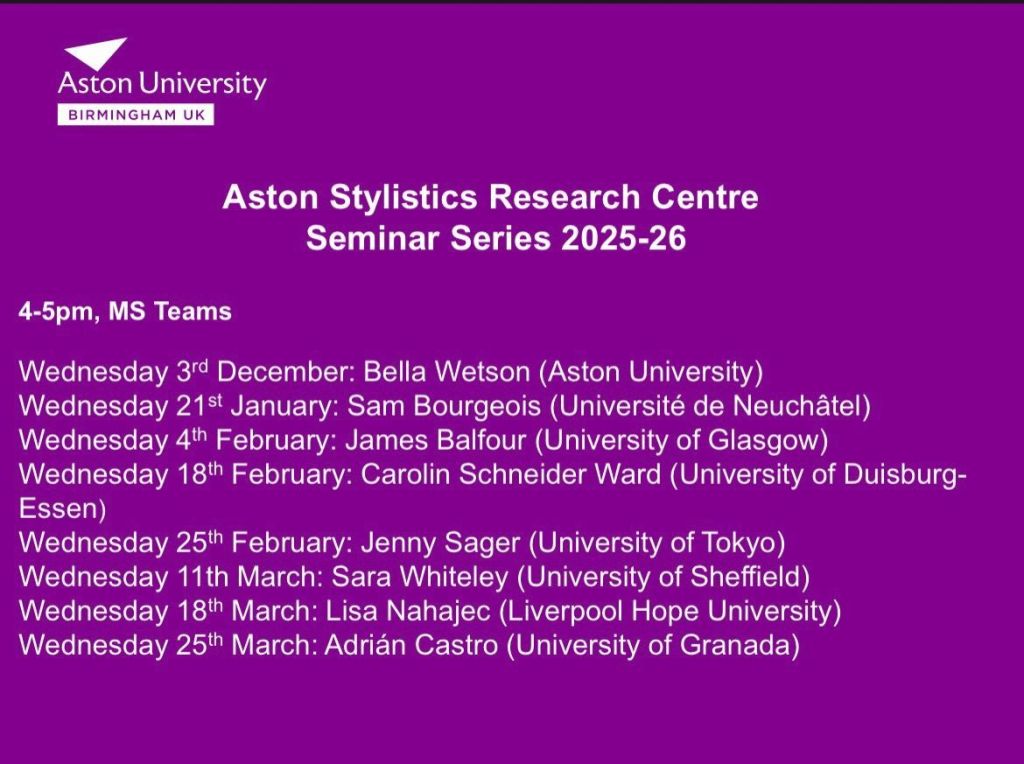
Applied Stylistics Seminar – Dr Lisa Nahajec
Can AI do stylistics (and do we want it to)?
18th of March 2026, 4-5pm, Teams
Book your place here and find more details about the talk below:
Dr Lisa Nahajec is Senior Lecturer in English Language at Liverpool Hope University. She has published widely on linguistic negation in different kinds of communication from political interviews to song lyrics. She is currently working on a project on how written language is used in the landscape of filmed drama and what this contributes to the construction of fictional worlds.
One of the core strengths of stylistics is its methodological eclecticism. Stylisticians routinely borrow from other disciplines — from schema theory to corpus-driven methodologies — selecting analytical tools appropriate to the interpretive task at hand. Yet this flexibility is grounded in shared principles: stylistic analysis must account for the interpretative effects of linguistic choice (Short 1996) through rigorous, replicable, and retrievable engagement with textual evidence (Simpson 2025). Stylistics is eclectic but it is not impressionistic.
If large language models can generate systematic linguistic observations, identify patterns, and propose interpretive effects, they appear, at least superficially, well suited to stylistic analysis. Contemporary AI systems produce fluent close-reading-style commentary with ease. But does the production of plausible analytical prose amount to doing stylistics?
Within pedagogical stylistics, analysis is understood not as polished commentary but as methodologically grounded practice through which learners develop interpretive, evidential, and explanatory competence (Carter, 1982; Simpson, 2004). Stylistics is explicitly taught, scaffolded, and assessed as disciplinary reasoning rather than as transferable textual observation. Although recent research shows that large language models can reproduce stylistic terminology and analytical discourse (Chaudhuri et al., 2023; Liu et al., 2024), such studies largely evaluate stylistic performance rather than stylistics as pedagogical or epistemic practice.
This paper argues that assessing whether AI can ‘do stylistics’ requires attention to the criteria central to pedagogical stylistics: methodological coherence, evidential accountability, and the capacity to explain how linguistic form generates meaning, context, and readerly effect.
References
Carter, R. (1982) ‘What is stylistics and why can we teach it?’, Language and Literature, 1(1), pp. 1–18.
Chaudhuri, B., Kestemont, M. and Luyckx, K. (2023) ‘Looking for the inner music: probing large language models’ understanding of literary style’, Computational Humanities Research, 2023, pp. 1–18.
Liu, Y., Zhang, R. and Wang, X. (2024) ‘Do artificial intelligence chatbots have a writing style? A linguistic analysis of ChatGPT-generated texts’, Journal of Artificial Intelligence Theory and Applications, 2(1), pp. 1–15.
Short, M. (1996) Exploring the language of poems, plays and prose. London: Longman.
Simpson, P. (2025) Stylistics: a resource book for students, 3rd edition. London: Routledge.
 appliedstylistics.com