Applied Stylistics Seminar – Dr Sara Whiteley
The Language of Kazuo Ishiguro: a corpus and cognitive stylistic approach
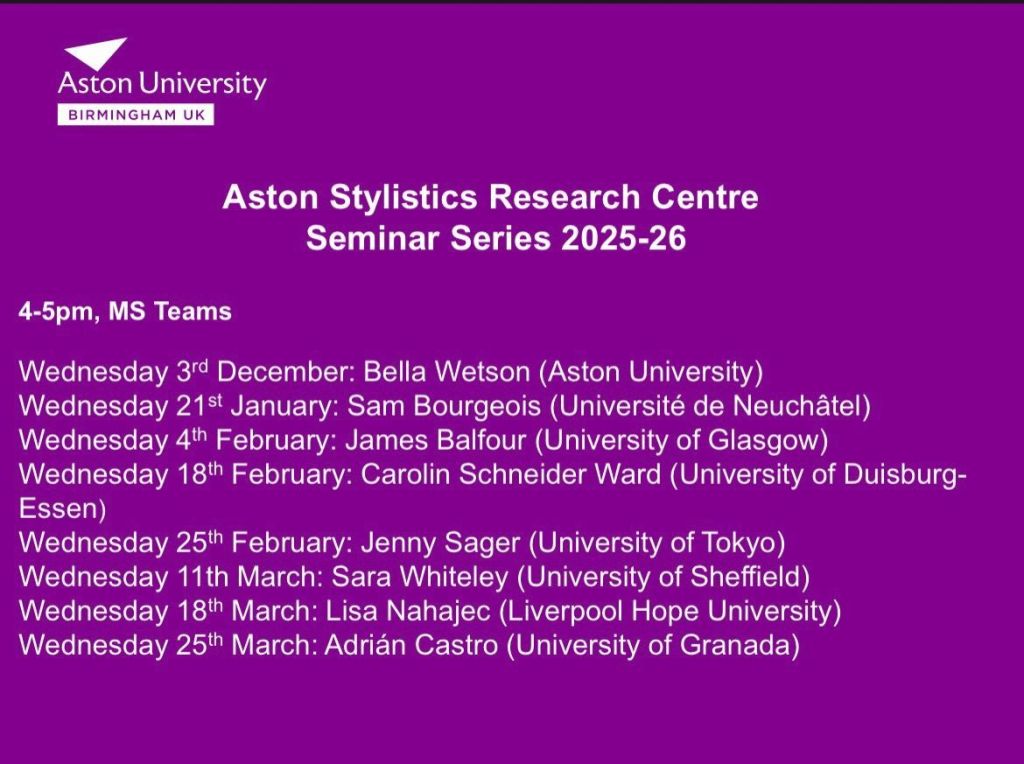
11th of March 2026, 4-5pm, Teams
Book your place here and find more details about the talk below:
Dr Sara Whiteley is Senior Lecturer in Language and Literature at the University of Sheffield, UK. She specialises in cognitive discourse analysis and the cognitive stylistics of contemporary literary texts. She has published articles on literary prose, poetry, song lyrics, telecinema, guestbook discourse and reading group talk. She is co-author of Contemporary Stylistics: Language, Cognition, Interpretation (Edinburgh University Press, 2018); The Discourse of Reading Groups: Integrating Cognitive and Sociocultural Perspectives (Routledge, 2016), and co-editor of The Cambridge Handbook of Stylistics (Cambridge University Press, 2014).
This paper reports on a project-in-progress which combines corpus and cognitive stylistic methods in order to investigate the style of contemporary writer Kazuo Ishiguro.
Ishiguro is the author of eight novels and won the Nobel Prize for Literature in 2017. Literary critics regard Kazuo Ishiguro as a unique writer, yet tend to describe his style as linguistically unremarkable. Each of Ishiguro’s novels establish narrators who are ‘rhetorically idiosyncratic’ (James 2009: 54), yet Ishiguro is often quoted as saying that he writes the ‘same book over and over’ (The Guardian 2015), establishing technical and thematic similarities across his works. The project interrogates these potentially paradoxical perceptions of Ishiguro’s style.
From a corpus stylistic perspective, I will discuss the creation of suitable focal and reference corpora and their comparison using tools such as Antconc, Wmatrix and Stylo in R. Ishiguro’s type:token ratios, sentence lengths, proportion of quoted speech, and key word classes, phrases and semantic domains will be explored. Using the corpus findings to direct my cognitive work, I will examine key linguistic features which appear across Ishiguro’s narrators in particular, and consider the contribution they make to the effects of his writing for readers.
 appliedstylistics.com